

You start looking at diamond rings, and within an hour you are reading a string of letters and numbers that nobody explains. D, G, VS2, 0.75ct, Excellent. Each listing assumes you already know what they mean, and the ones that look similar carry very different prices.
Those codes all trace back to the 4Cs of diamonds: cut, color, clarity and carat. This guide walks through each one in plain terms, then covers the part most buyers miss, which is how the same four measures work for a lab-grown diamond and what they can and cannot tell you about a simulated stone. Grading for lab-grown diamonds changed in 2025, so some of what you may have read is now out of date.
What are the 4Cs of diamonds?
The 4Cs are four traits used to describe and compare a diamond's quality. The Gemological Institute of America (GIA) created the system, and its founder Robert M. Shipley coined the term "the 4Cs" in the 1940s. The point was to replace vague terms like a "fine white stone" with four factors you can actually measure.
Because the 4Cs are measurable, two natural stones with the same cut, color, clarity and carat should look and cost broadly alike, wherever you buy them. Each C is graded on its own scale, so it helps to take them one at a time, starting with the one that does the most for how a stone actually looks.
Cut: where the sparkle comes from
Cut has the biggest effect on how a diamond looks. It measures how well a stone's facets are shaped and arranged to return light to your eye, which is what you read as sparkle and brightness. A poorly cut stone looks dull even if its other three grades are high.
GIA grades cut for the standard round brilliant on five levels, from best to worst: Excellent, Very Good, Good, Fair and Poor. This cut grade system was introduced in 2006, later than the other scales, because judging how light behaves took years to standardize. For a round stone, cut is the one grade where paying up is almost always worth it.
Cut grade vs diamond shape
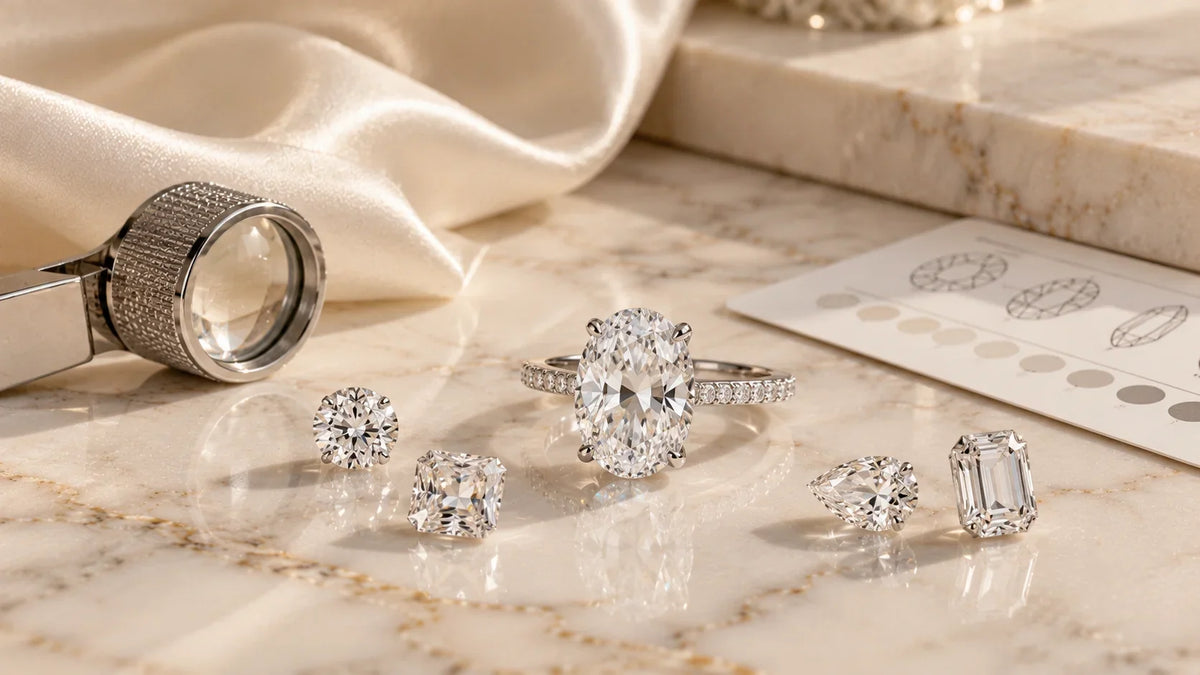
Cut is often confused with shape. Cut grade is about the quality of the faceting. Shape is the outline of the stone: round, oval, pear, emerald and so on. They are not the same thing, and you can have an excellent cut in any shape or a poor one.
One real limit matters here. GIA issues an official cut grade only for the round brilliant. Fancy shapes such as pear, oval and emerald do not receive a GIA cut grade at all, so for those you judge the cutting by eye and by the stone's proportions rather than a single letter. Dani's lab-grown rings show the range of shapes: the Celeste Pear ring in a pear outline, the Modern Oval ring in an oval, and the Classic Emerald ring in the step-cut emerald shape. None of those shapes carries a GIA cut grade, which is normal, not a gap.
Color: the D-to-Z scale
Color in a white diamond means the absence of color. The less tint a stone has, the rarer it is. GIA grades it on the D-to-Z scale, introduced in 1953, where D is the top of the range and completely colorless, and Z shows a noticeable light yellow or brown tint.
The scale sorts into bands, which is the useful way to think about it:
- D to F: colorless
- G to J: near colorless
- K to M: faint color
- N to R: very light color
- S to Z: light color
The near-colorless G-to-J band is the common value sweet spot, because the slight warmth is hard to see once a stone is set, especially next to metal. Your color choice also interacts with the setting: a faint tint shows more against white gold or platinum, and less against yellow gold, so the metal you pick changes what you actually see.
Clarity: from flawless to included
Clarity describes the tiny natural marks inside and on a stone, called inclusions and blemishes. GIA grades it under 10x magnification on an eleven-step ladder, from highest to lowest:
- FL and IF: flawless and internally flawless
- VVS1 and VVS2: very, very slightly included
- VS1 and VS2: very slightly included
- SI1 and SI2: slightly included
- I1, I2 and I3: included
The word to anchor on is eye-clean, meaning no inclusions are visible to the naked eye at normal viewing distance. You do not need a flawless stone to get there. On this clarity chart, a VS grade is eye-clean for most jewelry, and many SI1 stones look clean too, so the magnified grade often matters more to the price than to the look.
Carat: weight, not size
Carat measures weight, not size. One metric carat equals 0.2 gram, and it divides into 100 points, so a half-carat stone is 50 points or 0.50ct.
Weight and face-up size are related but not the same. Two stones of equal carat weight can look different across the top, because shape and cutting spread the weight differently: an elongated oval can read larger than a round of the same weight, while a deep-cut stone hides weight below the surface. When a piece holds more than one stone, the figure quoted is usually the total carat weight of all of them combined, not the size of any single stone, which is worth checking before you compare two pieces.
Do the 4Cs apply to lab-grown diamonds?
Yes, because a lab-grown diamond is a real diamond. It has the same physical and chemical properties as a mined one; the only difference is that it was grown in a controlled setting rather than underground. So cut, color, clarity and carat describe a lab-grown stone exactly as they describe a mined one.
What changed in 2025 is not the stone but the label on the paperwork, and the two major laboratories now handle it differently. That split is the single most useful thing to understand before you shop, and it is new enough that older guides get it wrong.
IGI and GIA grading for lab-grown diamonds
GIA changed its approach first. Announced in June 2025 and effective October 1, 2025, GIA stopped applying its natural-diamond D-to-Z color scale and FL-to-I3 clarity scale to laboratory-grown diamonds. Instead of a color letter and a clarity grade, a GIA lab-grown report now describes the stone with one of two terms: "Premium" or "Standard."
The International Gemological Institute (IGI) took the other path. Per an IGI statement dated July 16, 2025, IGI continues to grade laboratory-grown diamonds on the full 4Cs, using the same color, clarity and cut scales it applies to natural diamonds. So the practical 4Cs picture for a lab-grown diamond now depends on which lab graded the stone: IGI gives you the familiar letter and grade, while GIA gives you Premium or Standard. If you want to compare lab-grown stones the old way, look for an IGI report. If you are deciding between lab-grown and simulated stones in the first place, this plain-language comparison is a good next read. Browse Dani's lab-grown collection in 18K gold to see these shapes and sizes in finished pieces.
How the 4Cs work for simulated diamonds
A simulated diamond is a different case, and the 4Cs do not fully apply. Simulated stones are not diamonds. They are made to look like diamonds, but their material is different, so they are not graded on the diamond 4Cs and they do not come with a GIA or IGI diamond grading report. There is no color letter and no clarity grade to quote, because those scales measure diamond, and a simulant is not diamond.
Two of the four ideas still carry over in a looser sense. Cut, polish and shape still affect how a simulated stone catches light, so a well-made one looks better than a sloppy one. And size is described using "diamond equivalent" carat, meaning the weight a real diamond of that size would have, rather than a graded diamond carat. Dani's Classic Line Bracelet in sterling silver uses that wording, set with round simulated diamonds totaling 0.5ct diamond equivalent, which tells you the size without claiming a grade the stone cannot earn. If you are weighing a simulant against a lab-grown stone, this breakdown of lab diamond versus cubic zirconia spells out the difference.
Which of the 4Cs matters most?
For most budgets, the order that gets you the best-looking stone is cut first, then carat, then color, then clarity. The reasoning follows how the eye actually reads a diamond.
Cut comes first because it drives the sparkle you notice from across a room, and a dull stone cannot be rescued by its other grades. Carat comes next, since visible size is what most people want from the stone. Color and clarity come last for a simple reason: a near-colorless stone in the G-to-J band and an eye-clean VS stone look, to the naked eye, much like the flawless D stone that costs far more.
Say you have a fixed budget and a round stone in mind. Spend to secure an Excellent or Very Good cut, pick a size you are happy with, then settle color somewhere in G to J and clarity around VS. The money you save by not chasing a D color and a flawless grade, which you could not see once the stone is set anyway, goes into cut and carat, where it shows. A common mistake: buyers pour the budget into a top color and a flawless grade, then wonder why the stone looks smaller and flatter than a friend's cheaper one that was cut well.
Beyond the 4Cs: fluorescence, the report and the setting
The 4Cs cover the stone, but three more things shape what you end up wearing. Fluorescence is a faint glow some diamonds give off under ultraviolet light. It is listed on many reports and usually makes no visible difference indoors, so treat it as a detail, not a dealbreaker.
The grading report itself is the second. It is the independent record of what you are buying, which is why it matters who issued it and how recently, given the 2025 changes above. Read the lab name and the terms used before you trust a single grade.
The setting and metal are the last piece. The same stone looks different in white gold versus yellow gold, and the metal can flatter or expose a faint color grade, as the color section noted. A stone is only ever as good as the setting that holds and frames it, so judge the finished piece, not the certificate alone.
Common questions
What is the most important of the 4Cs?
Cut, for most buyers. It controls how much light the stone returns, which is the sparkle you see first, and a weak cut cannot be made up for by a high color or clarity grade. If you have to compromise to fit a budget, protect the cut and ease off on color and clarity instead.
Are lab-grown diamonds graded the same way as natural diamonds?
It now depends on the lab. IGI continues to grade lab-grown diamonds on the full 4Cs, the same scales it uses for natural stones, per its statement of July 16, 2025. GIA, effective October 1, 2025, describes lab-grown diamonds as "Premium" or "Standard" rather than giving a D-to-Z color or FL-to-I3 clarity grade. A lab-grown diamond is still a real diamond with the same properties as a mined one; only the reporting changed.
What clarity is eye-clean?
Eye-clean means no inclusions are visible to the naked eye at normal viewing distance. A VS1 or VS2 grade is eye-clean for most jewelry, and an SI1 often looks clean too, though that is worth confirming stone by stone. You rarely need to pay for a flawless grade to get a clean look.
What does "diamond equivalent" carat mean?
It is a size descriptor used for simulated stones, not a graded diamond weight. A "0.5ct diamond equivalent" simulant is cut to the size a 0.5-carat diamond would be, so you know how large it looks. It is not a diamond carat grade, because a simulated stone is not a diamond and does not receive a diamond grading report.
The bottom line
Learn the 4Cs in the order the eye reads them: cut makes the sparkle, carat sets the size, and color and clarity matter most on paper and least across a room. For a lab-grown diamond, remember the 2025 split, where IGI still uses the full 4Cs and GIA now says Premium or Standard. For a simulated stone, expect a "diamond equivalent" size rather than a grade.
Pick the cut first, choose the lab report you trust, then let color and clarity flex to fit the budget. To see the shapes and settings side by side, explore lab-grown diamond jewelry, or visit a Dani boutique to compare stones in person.

Leave a comment
This site is protected by hCaptcha and the hCaptcha Privacy Policy and Terms of Service apply.