
Article: Diamond Shapes Explained: Round, Oval, Pear, Emerald, Cushion and More
Diamond Shapes Explained: Round, Oval, Pear, Emerald, Cushion and More
Round still leads, but only just. In The Knot's 2026 Real Weddings Study of more than 10,000 couples married in 2025, round was the most popular of the engagement ring shapes, at 26%, just ahead of oval at 25%, as reported by Rapaport. Among lab-grown center stones, oval came first.
This guide to diamond shapes covers each outline, how it sparkles and how it wears, then helps you narrow it down. Dani makes these shapes in 925 sterling silver with simulated diamonds and in 18K gold with lab-grown diamonds; our guide to simulated vs lab-grown diamonds explains the difference.
Diamond shape vs diamond cut
Shape is the outline of the stone seen from above. Cut is how its facets are arranged and finished. "Oval" is a shape; how well that oval returns light is a matter of cut. For diamonds, GIA issues an official cut grade only for the round brilliant.
Shapes also fall into two cut styles:
- Brilliant cuts: round, oval, pear, cushion, radiant, princess, marquise and heart, faceted to scatter light into sparkle.
- Step cuts: emerald, asscher and baguette, with long, parallel facets that give broad, mirror-like flashes.
Easy to get wrong: a square or rectangular outline does not make a stone a step cut. Radiant and princess are both brilliants.
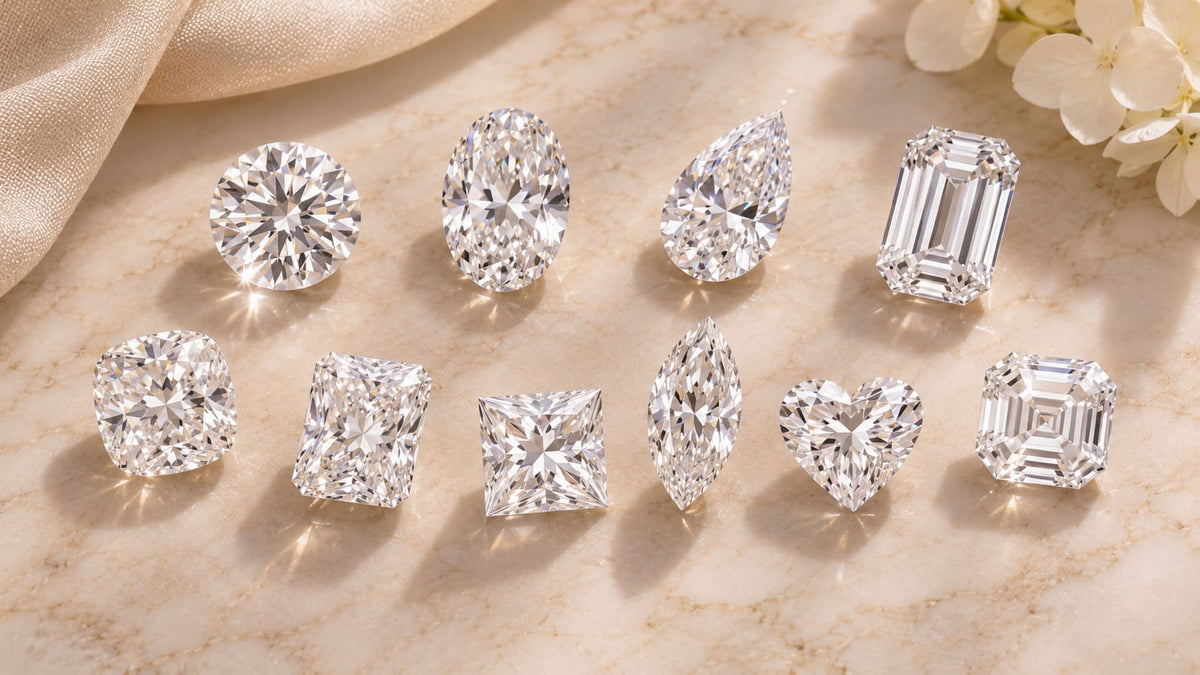
The main diamond shapes
The notes come from GIA's descriptions of diamonds, so they describe how each shape behaves, not a grade for any particular stone.
| Shape | Cut style | Known for |
|---|---|---|
| Round | Brilliant | The most brightness of all cuts |
| Oval | Brilliant | Looks larger; can show a bow-tie |
| Pear | Brilliant | Looks larger; a point to protect |
| Emerald | Step | Broad flashes; shows color and inclusions |
| Cushion | Brilliant | Warm, subtle sparkle; can look smaller |
| Radiant | Brilliant | "Crushed ice" sparkle; cropped corners |
| Princess | Brilliant | Square and bright; sharp corners |
| Marquise | Brilliant | Looks larger; tips to protect |
| Heart | Brilliant | Needs some size to read; a point to protect |
| Asscher | Step | Square, with an "X" pattern face-up |
Round brilliant
GIA describes the round brilliant as having the most brightness of all diamond cuts and calls it the top choice for engagement rings and fine jewelry of all styles. To wear the round look without committing to a ring, try classic four-prong round studs from our earrings. On simulated stones, a figure such as "2ct diamond equivalent" describes size, not a graded diamond weight.
Oval
The oval vs round diamond question comes down to length. GIA describes the oval as combining the fire and brilliance of a round with an elongated outline that creates the illusion of a larger size per carat, and it works in both vintage and modern settings.
A four-prong oval solitaire is the classic single-stone version, with prongs that let light in from beneath. In 18K gold, oval lab-grown diamonds also appear in continuous lines that wrap the finger. Compare both in our simulated diamond rings and lab-grown diamond rings.
Pear
A teardrop, rounded at one end and pointed at the other. Most pears are worn point toward the fingertip, though some wearers flip it.
In a solitaire, a pear is usually held with a prong guarding its point. In multi-stone designs, pear-shaped lab-grown diamonds are often set close together for a softer, flowing line.
Emerald
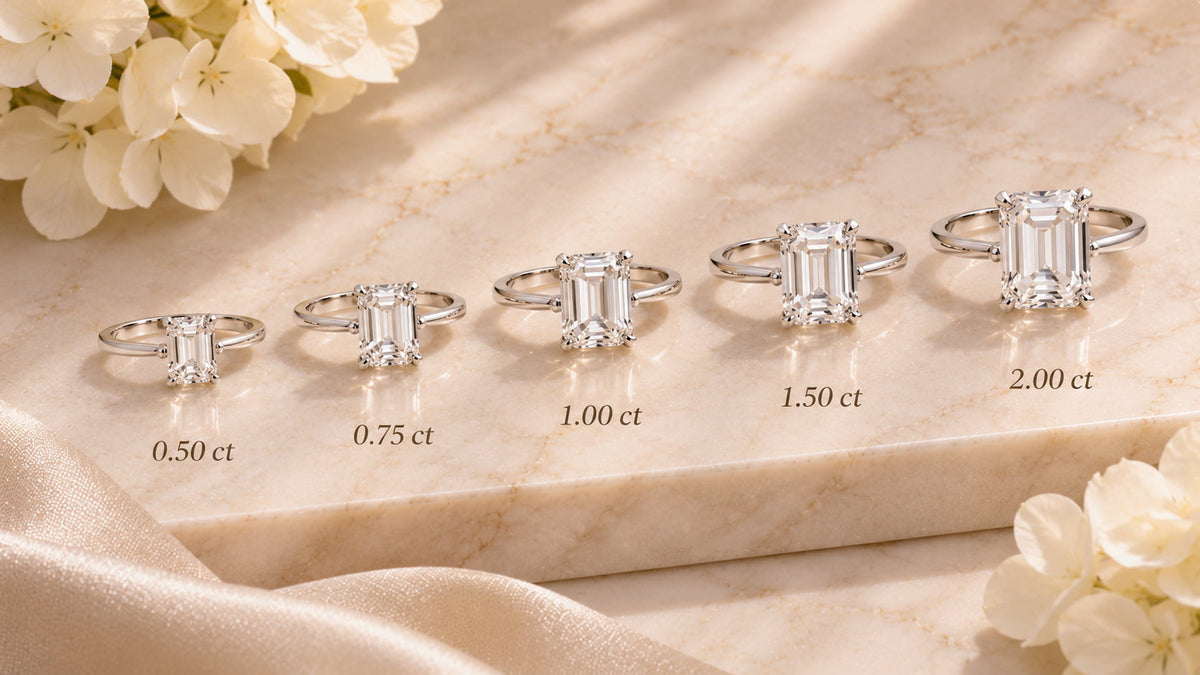
This is where step cuts make their case. In GIA's words, "unlike brilliant cuts that focus on sparkle, the emerald cut highlights clarity, symmetry and quiet sophistication." It suits minimalist, Art Deco or vintage-inspired settings.
The catch is those large, open facets. An emerald cut diamond shows color and inclusions more easily than other shapes, so for a lab-grown emerald cut, stone quality matters more. A simulated stone has no clarity grade to check: judge it by how clean and bright it looks to you.
In a four-prong solitaire, the long stepped facets of an emerald cut flash in broad planes rather than scattered sparkle. Set side by side along a band, emerald-cut lab-grown diamonds give a clean, architectural line.
Cushion
A square with rounded corners, often described as a cross between a round and a princess. GIA notes its warm, subtle sparkle and vintage feel. Its slightly deeper proportions can make it look smaller than other shapes of the same carat weight.
Radiant
The radiant combines the brilliance of a round with the clean lines of a square or rectangle. GIA calls it one of the most brilliant of the rectangular shapes, with trimmed corners and a crushed-ice look.
Princess
A square brilliant with sharp corners, and GIA describes it as modern elegance with brilliant sparkle. Those pointed corners are good at hiding inclusions. They are also its weak spot, which is why princess cuts are often set in a row across a band, where the corners are protected.
Marquise
According to legend, the marquise was named in the 1740s for the Marquise de Pompadour. It is long, with pointed tips, and often looks larger than other shapes of the same weight. GIA stresses that symmetry is especially important here.
Heart
The heart brilliant needs some size to read as a heart: for diamonds, GIA suggests 0.50 carat or larger. Look for evenly matched halves, prongs on the lobes and a setting that protects the point.
Which diamond shape looks biggest?
Elongated shapes. GIA says oval, marquise and pear can give the illusion of greater size. At the other end, cushion can look smaller than other shapes of the same carat weight, and princess slightly smaller than other square shapes such as asscher.
So carat is a poor yardstick across shapes, and the common mistake is comparing two stones by the number alone. Set an oval and a cushion with the same carat figure side by side, and the oval is the one likely to read larger. If size on the finger matters most, shortlist the elongated shapes and compare them face-up. For the carat question itself, see what size diamond an engagement ring should be.
Which diamond shapes are best for everyday wear?
A point is where a stone is most exposed. Pear, marquise, princess and heart all have points or sharp corners, which makes them more prone to chipping there. For diamonds, GIA recommends V-prongs or a setting that covers those points.
Radiant sits at the other end: its cropped corners help prevent chipping, which GIA calls a practical choice for everyday wear. Round and oval have no points at all, and cushion's corners are rounded.
So if your hands are busy all day, a pointed shape is a choice you make with your eyes open, not by default.
How to choose a diamond shape for your hand
According to GIA, elongated shapes such as oval, marquise and emerald make fingers look longer and slimmer. A common rule of thumb runs the other way for long fingers: wider shapes like round, cushion, princess and asscher sit well on them.
Here is how that plays out. Say your fingers are on the short side, you type all day and you love sparkle more than clean flashes. Sparkle means a brilliant cut, so emerald and asscher are out. Short fingers favor an elongated shape: oval, pear or marquise. Typing all day argues against tips, so pear and marquise drop out.
That leaves the oval: a single oval simulated diamond in sterling silver, or oval lab-grown diamonds in 18K gold. Our guide to choosing an engagement ring covers the setting and band questions that come next.
Diamond shapes beyond rings
Earrings and necklaces let you wear a shape you might not pick for a ring, such as oval studs. Our stud earring guide covers shapes in stud earrings in more detail.
A necklace can mix several shapes at once, such as marquise, heart and pear stones in one design. Browse our necklaces to see shapes side by side.
Diamond shapes FAQ
What is the most popular diamond shape?
Round, by one point. In The Knot's 2026 Real Weddings Study of couples married in 2025, as reported by Rapaport, round took 26% and oval 25%, while oval came first among lab-grown center stones.
Which diamond shape sparkles the most?
GIA describes the round brilliant as having the most brightness of all diamond cuts. Among rectangular shapes, the radiant is one of the most brilliant, with its "crushed ice" look.
Which shape looks biggest for its carat weight?
Oval, pear and marquise. Their elongated outlines can give the illusion of greater size.
What is the bow-tie effect?
The bow-tie is a darker area across the middle of the stone, shaped like two triangles meeting at the center. It shows up in oval, pear, marquise and heart shapes cut in the brilliant style, and in a well-cut stone it is subtle. To spot it, look at the stone face-up for a dark band across the center, and compare stones side by side.
The bottom line
There is no best shape. Choose the one you keep looking at, then pick a setting that protects it, especially if it has a point. This week, try on one round and one elongated shape, and look at your hand at arm's length. Then find your shape in our simulated diamond rings and lab-grown diamond rings, or browse our engagement rings and our pick of simulated diamond engagement rings.