
Article: The Tennis Bracelet Guide: Styles, Settings and How to Wear It
The Tennis Bracelet Guide: Styles, Settings and How to Wear It
A tennis bracelet looks like one of the simplest things in a jewelry box. It is a single line of matched stones around the wrist, and most people assume the only choice is how much it sparkles. But the details are what make two bracelets that look alike on screen wear very differently in real life.
This tennis bracelet guide covers what the piece actually is, the settings that decide how it catches light and how long it lasts, how to size one, and how to wear it. Dani's tennis bracelet collection runs from sterling silver to lab-grown diamond, so the examples here are real pieces rather than abstract types.
What is a tennis bracelet?
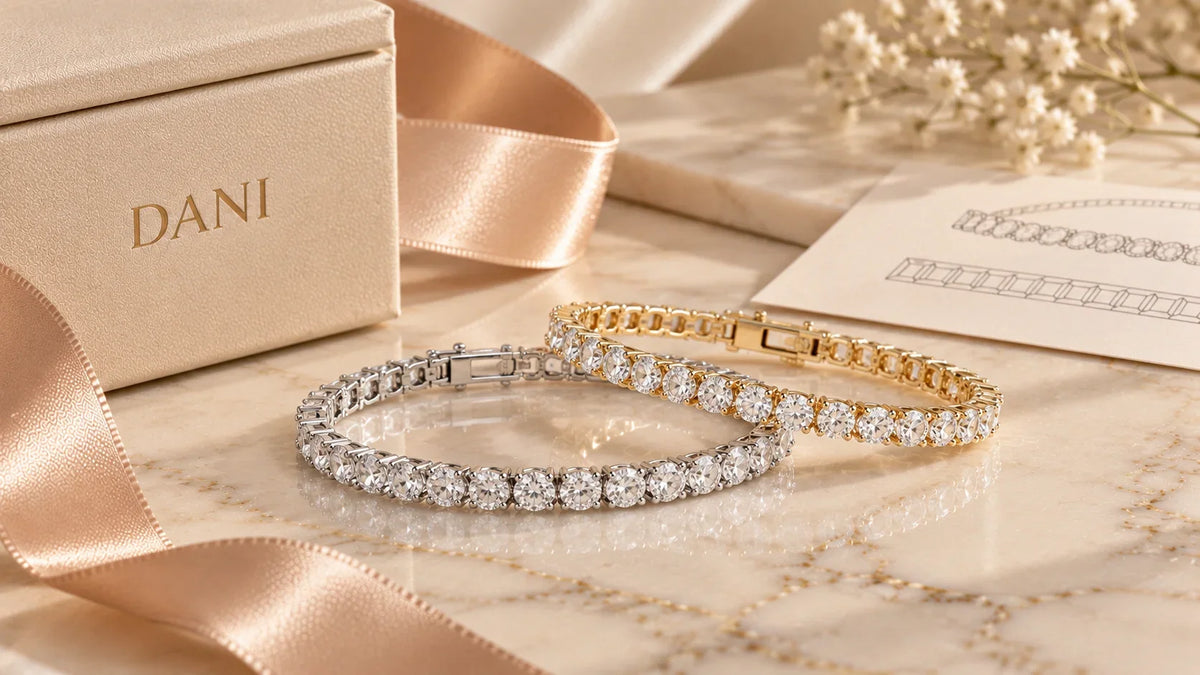
A tennis bracelet is a flexible bracelet of stones set in a continuous line around the wrist, usually the same cut and size, linked so the whole thing moves and lies flat. The look is deliberately plain. No single large stone, no pendant, just an even run of light.
So what is a tennis bracelet doing with a sports name? The term traces back to American tennis champion Chris Evert. During a match at the 1987 US Open her thin diamond line bracelet came loose, and play paused while it was recovered. The moment stuck, and people started calling the style a tennis bracelet. Before that it was known as an eternity bracelet or a line bracelet, names you still see today.
Tennis bracelet styles
Most of the variation in tennis bracelets comes down to three things: the cut of the stones, how evenly they are spaced, and how uniform the line reads overall. A classic round-cut line is the most familiar. Every stone is the same, set in a straight even row, which is the look people picture first.
From there, styles branch out. The Classic Eternal Round-Cut Bracelet and the Eternity Sparkle Tennis Bracelet sit at the classic end in sterling silver, and the DANI Classic Line Bracelet carries 0.5ct of round simulated diamonds. In lab-grown diamond and 18K gold, pieces like the Classic Mosaic, the Classic Symphony and the Modern Crown show how far the single-line idea stretches while keeping that clean shape.
Pick the style by how you plan to wear it, not by which looks busiest in a photo. A plainer even line layers under a watch and stacks with bangles far more easily than a heavily patterned one.
Setting types: prong, bezel and channel
The setting is the metal that holds each stone. It quietly decides both how much the bracelet sparkles and how well it survives daily life, and it is the part most buyers skip.
- Four-prong: small claws grip each stone and leave it mostly open, which lets in the most light and gives the brightest sparkle. The trade-off is that raised prongs can catch on fabric and need checking and tightening from time to time.
- Three-prong (martini): fewer claws and a lower V-shaped profile that sits closer to the wrist, using less metal. The stone sits a touch more exposed, so security depends on how well the head is made.
- Bezel: a continuous metal rim wraps the girdle of each stone. It is the most secure and protective option, the smooth edge resists snagging, and it suits active daily wear. It lets in less light than prongs, so it reads a little softer.
- Channel: small stones sit in a row between two metal walls that shield their edges, with nothing to snag. If one of those walls is damaged, more than one stone can loosen at once.
For everyday wear, bezel is the most protective and prong the most sparkling, while channel protects the edges of small stones. A common mistake is choosing on sparkle alone and ignoring how the setting will hold up on a wrist that goes everywhere.
Lab-grown diamond or simulated diamond?
These two terms get mixed up constantly, and the difference is worth getting right before you buy. A simulated diamond is a different material made to imitate the look of a diamond. It is not a real diamond. A lab-grown diamond is a real diamond grown in a lab, with the same physical properties as a mined, natural stone. Dani's guide to simulated diamond versus lab-grown diamond covers the full breakdown.
At Dani, the split is simple. The sterling silver tennis bracelets, including the Classic Line, the Classic Eternal and the Eternity Sparkle, are set with simulated diamond. The 18K white gold pieces, the Signature Tennis Lab Grown Diamond Bracelet, the Classic Mosaic, the Classic Symphony and the Modern Crown, are set with lab-grown diamond.
One term to understand here is total carat weight, written as tcw. It is the combined weight of every stone, not the weight of one. For example, a bracelet with 5ct spread across 50 stones averages out to 0.1ct each. On a tennis bracelet the number describes the full line, so a high figure spread across many stones still reads as an even row, not one large sparkle.
Choosing the metal
Dani's silver tennis bracelets are 925 sterling silver with a rhodium finish, a bright white plated surface that gives the metal a cool, reflective look. The gold tennis bracelets are solid 18K white gold, a precious metal all the way through.
If you have seen 18K gold described as yellow or rose elsewhere, that is correct in general: 18K comes in those tones too. The gold tennis bracelets shown here are white gold, which keeps the focus on the stones and sits easily next to steel watches. Choose silver for a lighter everyday piece, and lab-grown diamond in 18K white gold when you want precious metal and real diamonds.
How to find the right tennis bracelet size
Fit is where a tennis bracelet is either a pleasure to wear or a constant annoyance. Dani's tennis bracelets are listed in lengths between 15cm and 22cm, or about 6 to 8.7 inches. The DANI Classic Line Bracelet, for example, comes in three sizes, so check each product page for the lengths available.
To find your number, wrap a soft tape measure or a strip of paper snugly around your wrist just below the wrist bone, then read the measurement. Add a little length so the bracelet can move: around 1.5cm to 2cm over your bare wrist measurement is a comfortable starting point. You want it to settle on the wrist and shift slightly when you move your hand, not grip like a watch strap and not slide over the hand.
Clasps and safety features
A tennis bracelet is made of small hinged links, so the clasp takes strain every time you wear it. The common closure is a box clasp: a flat metal tongue slides into a box fitting and clicks when it is fully seated, which is the click you are listening for as you put it on.
Many tennis bracelets add a figure-8 safety catch as a backup. It is a hinged figure-8 loop that folds over the closed clasp, so if the main clasp springs open the catch keeps the bracelet on your wrist instead of on the floor. A closure you can work one-handed is one you will actually fasten properly every day.
How to wear a tennis bracelet
The strength of a tennis bracelet is that it goes with almost everything, which makes it easy to default to one way of wearing it and miss the rest.
On its own
Worn alone, a tennis bracelet does the most work with the least effort. On a bare wrist the single line of light reads as quietly dressed up, which is why a tennis bracelet in Dubai suits an office day, dinner or an evening out without any styling at all.
With a watch
Pair it on the same wrist as a watch and the metals should agree. A rhodium-finished silver bracelet or a white gold one sits naturally beside a steel or white-gold watch, picking up the same cool tone. Keep the bracelet on the hand side of the watch so the two are not fighting for the same spot.
Stacked with bangles
Stacking is where a tennis bracelet works especially well. Run it between a couple of plain bangles and it adds a line of sparkle without taking over. If you are new to layering, Dani's guide to mixing and matching jewelry is a good place to start. The simplest rule: keep the metals in the same family and let the tennis bracelet be the one piece that shines.
Caring for your tennis bracelet
Day-to-day care is mostly gentle habits. Put the bracelet on last, after perfume, lotion and hairspray, since those build up and dull the sparkle over time. Wipe it with a soft cloth after wearing, and store it flat and apart from harder pieces so the links and stones do not get scratched.
Every so often, give the setting a proper look. If your bracelet has prongs, check that none have bent or loosened, because a raised prong that has caught on fabric is the first warning that a stone could come loose. For cleaning routines by stone type, Dani's guide to caring for simulated diamonds covers what to do and what to avoid.
Common questions
Why is it called a tennis bracelet?
The name traces to American tennis champion Chris Evert, whose thin diamond line bracelet came loose during a match at the 1987 US Open. Play paused while it was recovered, and the term tennis bracelet stuck to that style. Before then the style was called an eternity or a line bracelet.
Can you wear a tennis bracelet every day?
Yes, and many people do. The key is the setting and the clasp: a protective setting such as a bezel handles daily wear well, a secure clasp with a safety catch keeps it on, and a quick check of the stones from time to time catches a loose setting early.
How many carats should a tennis bracelet be?
There is no single right answer. Total carat weight is the combined weight of all the stones, not one stone, so a higher number is spread across the whole line. Choose by the look you want, a finer line or a bolder one, and by your budget rather than chasing a figure.
Should a tennis bracelet be tight or loose?
Snug, with a little movement. It should settle on the wrist and shift slightly when you move your hand, without sliding over the hand or gripping like a watch strap. Measure your wrist just below the wrist bone, add roughly 1.5cm to 2cm, then choose the closest available length.
The bottom line
Start with how the bracelet will live on your wrist. Decide whether you want a simulated diamond in sterling silver or a lab-grown diamond in 18K white gold, pick a setting that matches how roughly you wear jewelry, then size it snug with a little room to move. Get those three right and the style almost chooses itself.
Shop tennis bracelets in sterling silver and lab-grown diamonds.