

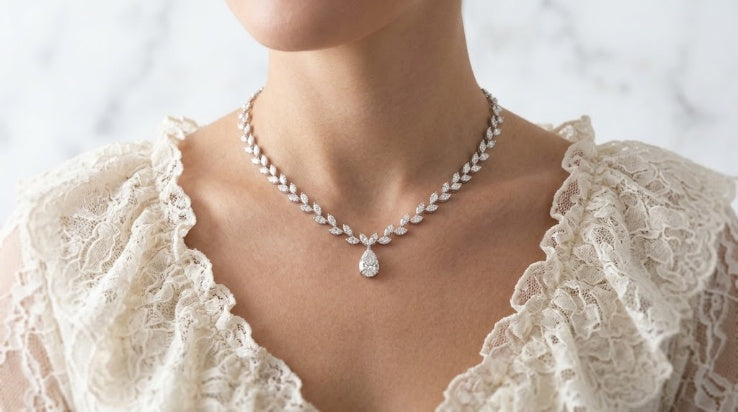
You're browsing a jewelry site, you find a piece you like, and the description calls it a pendant. The next one is called a pendant necklace. Are they the same thing? Not quite, though the difference is smaller and simpler than it sounds. If you're new to fine jewelry, here's what a necklace pendant actually is, the other necklace styles you'll run into while shopping, and how to choose a first piece without second-guessing yourself.
None of these terms are a test. You can shop happily without knowing a single one. But a little vocabulary makes product descriptions easier to read, and it helps you picture how a piece will sit before it arrives.
What is a necklace pendant, exactly?
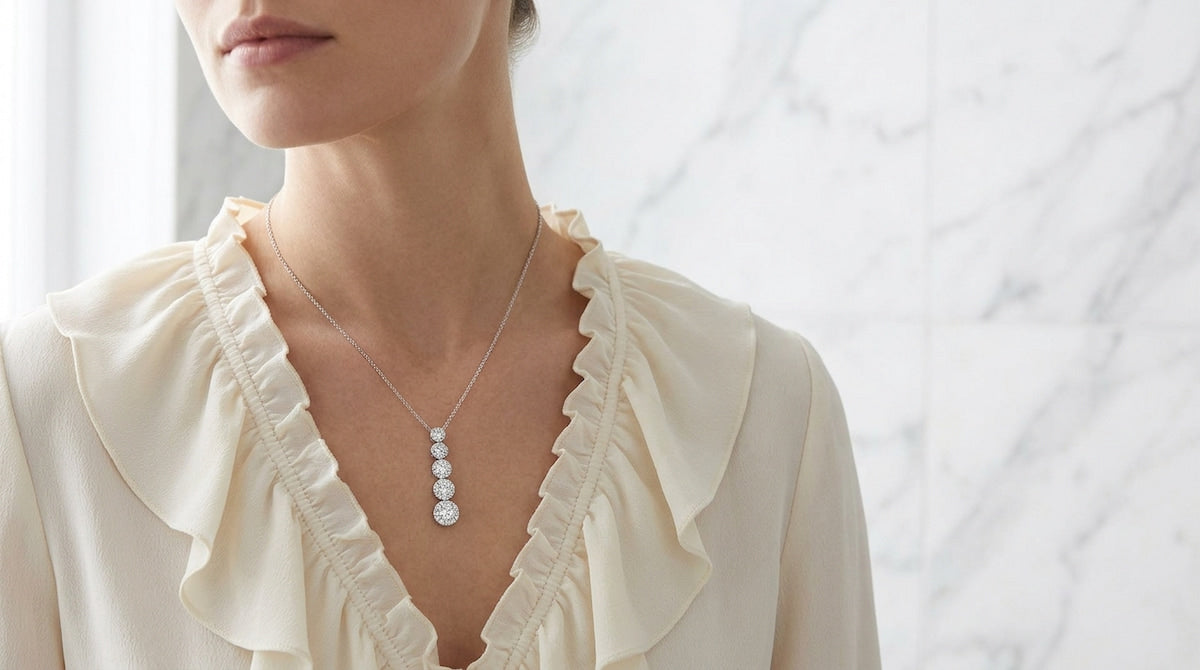
A pendant is the decorative ornament that hangs from a chain or cord. It's the hanging piece itself: a small gold disc, a single lab-grown diamond, an initial, a charm. On its own, a pendant is just that ornament, usually with a small loop at the top so it can hang from something.
A pendant necklace is the whole piece: a chain (or cord) plus the pendant it carries. That's really all the pendant necklace meaning comes down to. The pendant is the ornament, and the pendant necklace is the finished piece.
Which leads to a mix-up worth clearing up: calling the entire necklace a "pendant." It's an easy slip, and no one in a shop will mind. But if you want the exact distinction, and a closer look at how the words "necklace" and "pendant" split apart, we walk through it in our guide to the difference between a necklace and a pendant.
A beginner's glossary of necklace types
Here are the styles you'll see named most often. Skim it once, and come back when a product description uses a word you don't recognize. These are general jewelry terms worth knowing as you shop around, not a checklist any single brand carries.
Chain
A chain, as a style, is a necklace made of connected metal links worn on its own, with no pendant and no stones. Picture a plain gold chain that needs nothing else to look finished. Here's where the word gets slippery: "chain" also names the strand that any pendant hangs from. So a chain can be the whole necklace, or it can be the part a pendant clips onto. Context tells you which one someone means.
Choker
A choker is a short necklace that sits high on the neck, close to the throat. Lengths vary from one source to the next, but they usually run around 14 to 16 inches. If a necklace sits snug instead of draping down the chest, it's probably in choker territory.
Lariat and Y-necklace
These two names get used interchangeably, and there's no single strict definition. Broadly, both describe a long style that drapes into a Y shape at the front. Classically, a lariat is clasp-free with dangling ends you can loop or knot, while a Y-necklace forms that Y and may have a clasp. In practice, you'll see the two labels swapped freely, so don't read too much into which one a listing uses.
Pendant necklace
You already know this one from the section above: a chain or cord carrying a single ornament. It's a familiar starting point for beginners, because one pendant adds personality without much fuss.
Station necklace
A station necklace spaces stones, beads, or small motifs at intervals along the chain. Those spaced details are the "stations." Instead of clustering everything in one spot at the center, the detail is spread evenly along the length, which gives the piece a steady, repeating rhythm.
How to pick your first pendant necklace
Start with where it will sit. Necklace lengths have names, and they all shift a little depending on the source, so treat these as rough guides rather than fixed rules:
- Collar, around 12 to 13 inches
- Choker, around 14 to 16 inches
- Princess, around 17 to 19 inches
- Matinee, around 20 to 24 inches
- Opera, around 28 to 36 inches
- Rope, 36 inches and longer
For a first pendant necklace, a princess length is a comfortable default. It tends to land near the collarbone and works with many necklines, so it's an easy place to begin before you know your preferences.
Then think about metal. If you want a piece that lasts and stays easy to wear, solid gold is a safe first choice. 18K yellow gold has a classic warm tone, while 18K white gold has a cooler, brighter look. Both go with a wide range of outfits, so pick the tone you already reach for most in the rest of your jewelry.
Here's a concrete example to tie it together. Say you want one everyday piece you can wear with almost anything. A single lab-grown diamond pendant on an 18-inch chain in 18K white gold gives you a princess-length necklace that sits at the collarbone, catches light on its own, and layers easily later if you decide to add pieces. One decision at a time, and you end up with something you'll actually reach for.
When you're ready to look, you can browse the necklace collection for chains and finished pieces, or explore our pendants if you want the ornament to lead.
Starting simple with your first necklace
You don't need to memorize any of this to shop well. Hold on to the difference between a pendant and a pendant necklace, remember that lengths and a few style names shift depending on who's describing them, and the rest settles in as you go. Pick one length and one metal tone you like, begin with a single pendant necklace, and build from there once you've seen how it wears on you.

اترك تعليقًا
This site is protected by hCaptcha and the hCaptcha Privacy Policy and Terms of Service apply.