
IGI vs GIA: How to Read a Lab-Grown Diamond Certificate
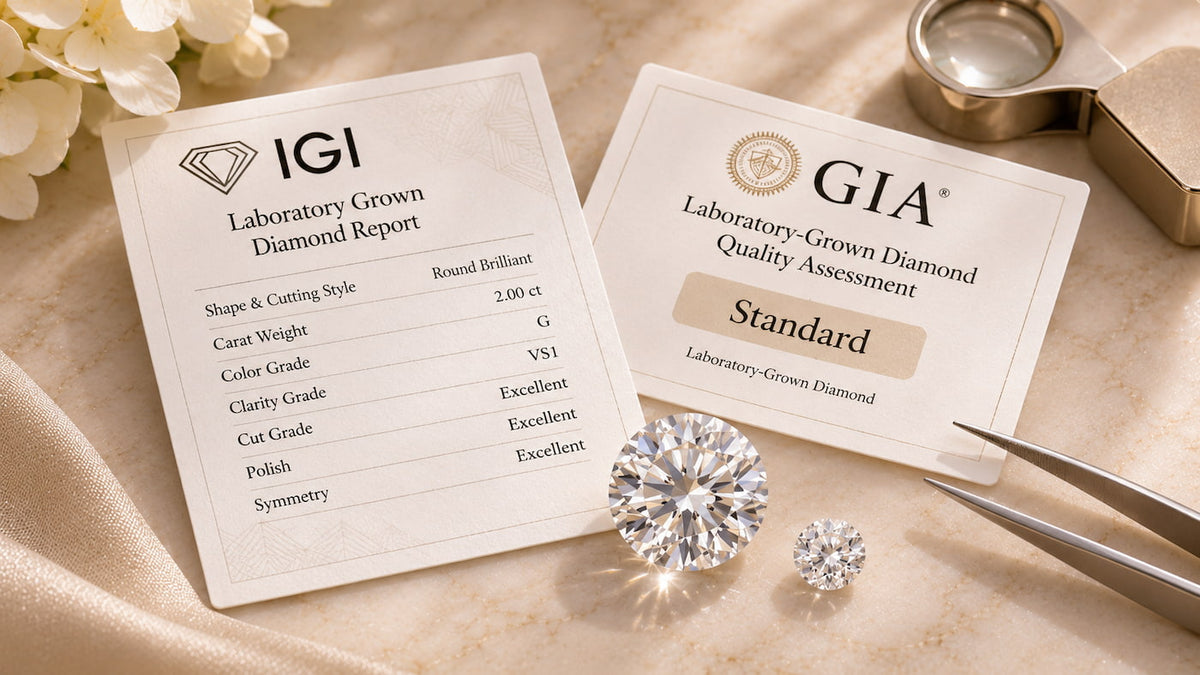
Two lab-grown round brilliants are on your shortlist. One comes with an IGI report reading G color, VS 1 clarity and Excellent cut. The other has a GIA document that places it in a category called Standard.
Which is better? The papers cannot say, because they answer different questions. This guide to IGI vs GIA covers what each lab now reports, how to read a diamond certificate, and how to check that a report belongs to your stone.
What is a lab-grown diamond grading report?
A grading report is an independent lab's record of one stone: what it is, how it measures and how it scored on the lab's scales. Buyers often call it a certificate. IGI calls it a report; GIA now calls its lab-grown version a quality assessment.
For lab-grown stones, the paper does extra work. IGI's fine print says a laboratory grown diamond "has essentially the same chemical, physical and optical properties as a mined diamond." The FTC requires sellers to disclose a lab-grown stone clearly, as "laboratory-grown" or "laboratory-created", and the report is the independent record behind that label.
IGI and GIA: who they are
The Gemological Institute of America (GIA) was established in 1931 and is a nonprofit institute headquartered in Carlsbad, California. It created the 4Cs grading system in the 1940s.
The International Gemological Institute (IGI) was founded in Antwerp, Belgium, in 1975. It is an independent gemological laboratory and began grading lab-grown diamonds in 2005.
How IGI and GIA grade lab-grown diamonds today
IGI still grades lab-grown diamonds on the full 4Cs. GIA now places them in one of two categories, Premium or Standard.
IGI reports: a grade for each C
In July 2025, IGI said it "will continue applying the universal 4Cs grading to all diamonds, whether natural or lab-grown." Its reason: "to prevent industry and consumer confusion." An IGI certified lab-grown diamond comes with a Laboratory Grown Diamond Report that grades color, clarity, cut and carat.
GIA's quality assessment: Premium or Standard
GIA announced the change on June 2, 2025, in effect from October 1, 2025. Colorless to near-colorless lab-grown diamonds now receive a GIA Laboratory-Grown Diamond Quality Assessment, which GIA describes as an "overall quality evaluation that classifies each laboratory-grown diamond as Premium or Standard."
- Premium: color D, clarity VVS or higher, polish and symmetry Excellent, cut grade Excellent (round brilliants only). A stone must meet all of them.
- Standard (minimums): color E to J, clarity VS, polish Very Good, symmetry Very Good (Good for fancy shapes), cut grade Very Good (round brilliants only).
A stone that falls below the Standard minimums gets no GIA assessment at all.
GIA uses color, clarity and finish to place the stone in a category, so the new document gives no D-to-Z color grade and no clarity grade. A printed document comes back with the stone.
A GIA lab-grown diamond report issued before October 2025 may still show D-to-Z color and clarity grades, and it remains valid.
Worked example: one stone, both labs
Suppose GIA examined the IGI-graded stone from the shortlist and reached the same results: G color, VS 1 clarity, Excellent cut, polish and symmetry.
- G sits inside Standard's E-to-J color range.
- VS 1 meets the VS clarity minimum.
- Excellent cut, polish and symmetry clear every other Standard minimum.
So it would be Standard, missing Premium on two counts: Premium needs color D and clarity VVS or higher. Drop the clarity below VS and GIA would issue no assessment at all.
An easy mistake is reading "Standard" as a weaker stone than "G, VS 1". It is a category, not a grade on the same scale.
IGI report vs GIA assessment: which fields appear where
| What you want to know | IGI Laboratory Grown Diamond Report | GIA Quality Assessment (since October 2025) |
|---|---|---|
| Lab-grown statement | Title reads "Laboratory Grown Diamond Report" | Confirms the item is a laboratory-grown diamond |
| Unique number | Report number (sample numbers begin "LG") | Quality assessment number |
| Color | D-to-Z letter grade | No letter grade; used for the category |
| Clarity | Grade such as VVS 2 | No clarity grade; used for the category |
| Cut, polish, symmetry | Graded, for example Excellent | Used for the category; cut for round brilliants only |
| Overall result | A grade for each C | Premium or Standard |
| Girdle inscription | Report number (on IGI's samples) | "Laboratory-Grown" plus the assessment number |
How to read a diamond certificate, section by section
This walk-through follows a typical IGI lab-grown report.
Report number and laser inscription
At the top sit the IGI Report Number and the date of grading. The number is what you look up online; on IGI's samples it begins "LG", as in LG589305825.
The inscription field shows the text laser-inscribed on the girdle, the stone's thin outer edge. On IGI's samples it repeats the report number, for example "LABGROWN IGI LG12379504". It is tiny, so reading it takes a jeweler's loupe, ideally 10x.
Shape, measurements and carat
Shape and cutting style names the outline and facet pattern, such as "Round Brilliant". Measurements give the stone's size in millimeters, for example 7.29 - 7.34 x 4.55 mm. Carat weight is the stone's weight, for example 1.51 carats.
Color, clarity and cut
Color is a letter grade, with D meaning colorless. Clarity reads like "VVS 2". Cut reads as a word such as "Excellent", though one 2021 IGI round sample reads "Ideal".
Polish and symmetry, the finish and alignment of the facets, sit under Additional Grading Information with fluorescence, the stone's glow under UV light.
The clarity plot maps the stone's characteristics on a diagram: "Red symbols indicate internal characteristics. Green symbols indicate external characteristics."
Growth method and treatments
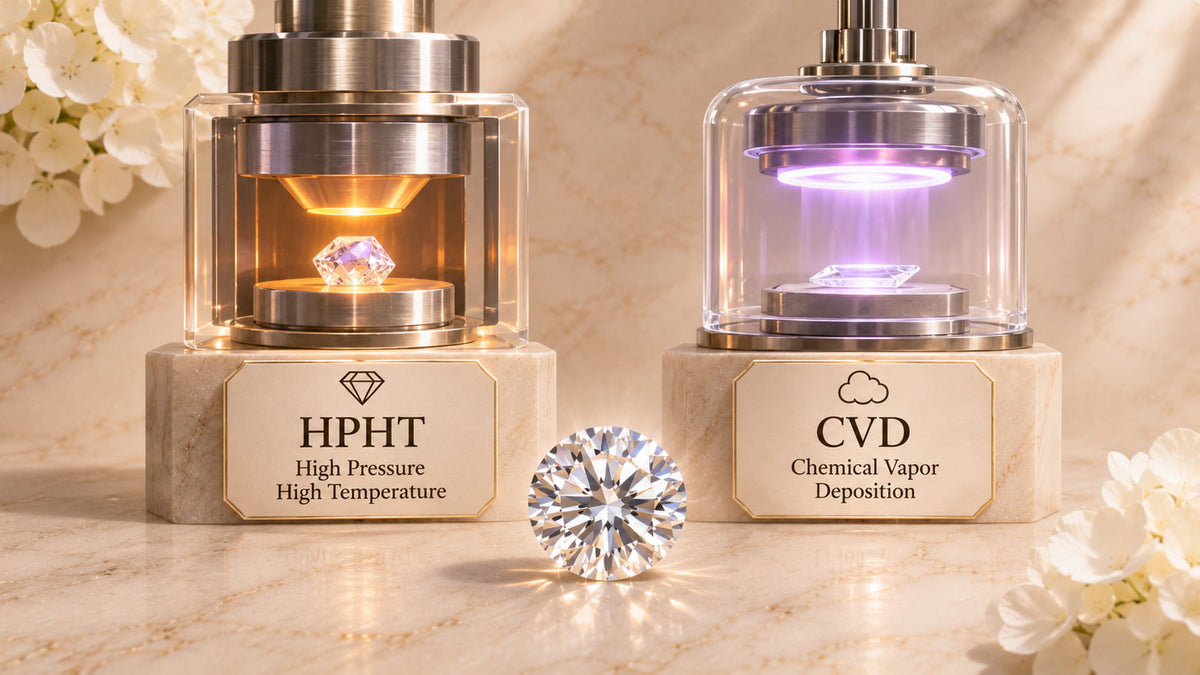
IGI reports can state the growth method, CVD or HPHT (high pressure, high temperature), in the comments, along with whether there is any sign of post-growth treatment. A typical line: "This Laboratory Grown Diamond was created by Chemical Vapor Deposition (CVD) growth process." HPHT can also be used after growth as a treatment, often to improve the color of CVD-grown diamonds.
Where IGI finds no sign of treatment, the comments read "As Grown", followed by "No indication of post-growth treatment." Where it finds signs, they read "Indications of post-growth treatment." Either way, it is disclosed so you know exactly what you are buying.
How to verify a lab-grown diamond report online
- Type the lab's address yourself instead of following a seller's link.
- For GIA, enter the report or quality assessment number in Report Check.
- For IGI, enter the report number at igi.org, as IGI's reports direct.
- Match that number to the girdle inscription under a 10x loupe.
GIA's FAQ is plain: "If it can be found on Report Check, the report is authentic." A genuine report still has to match your stone, and only step 4 checks that.
What a diamond report doesn't tell you
A report records one stone in grades and millimeters. It is not a valuation or appraisal, as IGI's reports state. Nor can it show how a stone looks once set, how it catches light, or how it sits against white or yellow gold.
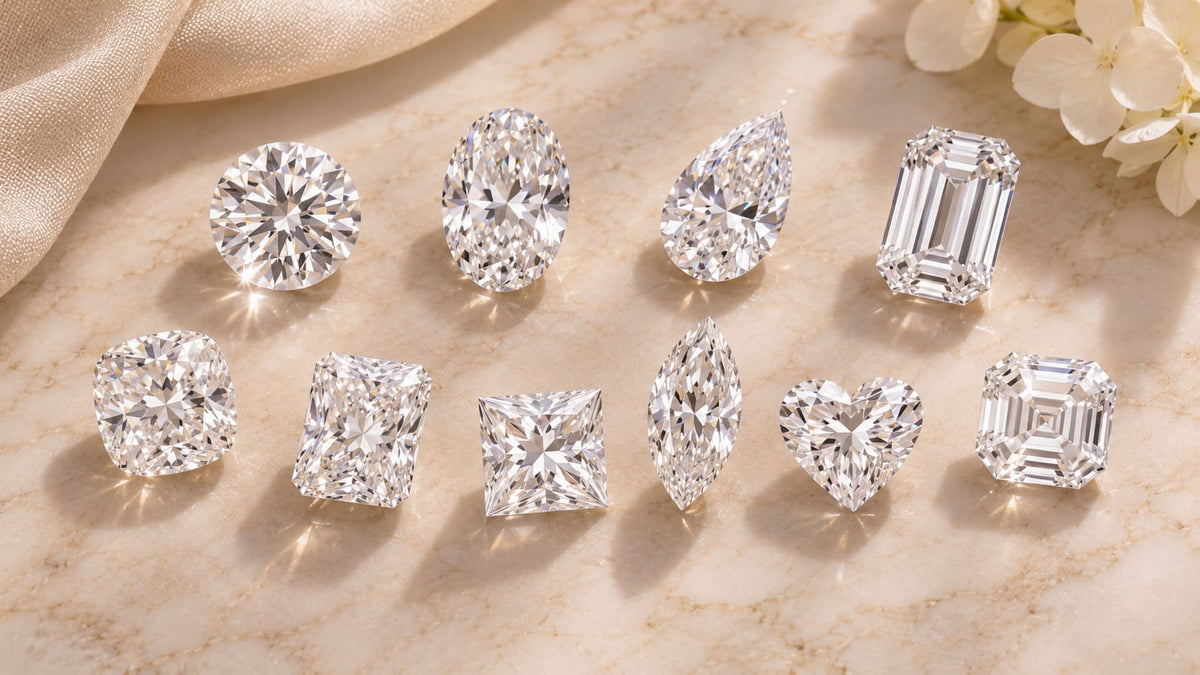
Dani's lab-grown pieces show why. Many designs combine several shapes, such as step-cut emeralds, round brilliants and pears, in 18K white or yellow gold, so no single report number describes how the finished piece looks.
In multi-stone designs like these, you judge the whole piece: how the shapes play off each other and how the gold frames them. See more in our lab-grown diamond rings and lab-grown diamond earrings.
Questions to ask before you buy a lab-grown diamond
- Which lab issued the report, and does it cover this exact stone?
- Does the report number match the girdle inscription?
- What do the comments say about growth method and treatment?
- For a GIA document, is it Premium, Standard, or an older report with letter grades?
Buying for a proposal? Our guide to choosing an engagement ring covers the rest of the decision.
IGI vs GIA FAQ
Is IGI or GIA better for lab-grown diamonds?
Neither is better on the record. They report differently, so the right one is the one whose format answers your question: individual grades, or an overall category.
Does a lab-grown diamond need a certificate?
No law requires one, although the FTC requires sellers to disclose a lab-grown stone clearly. A report is the independent record of what you are buying, and for a larger single stone it is worth asking for.
Does the report say the diamond is lab-grown?
Yes. An IGI report is titled "Laboratory Grown Diamond Report". GIA's assessment confirms that the item is a laboratory-grown diamond, and the girdle is inscribed "Laboratory-Grown".
What does "as grown" mean on a diamond report?
It means the lab found no sign that the stone was treated after it was grown, for example to change its color.
The bottom line
A report tells you exactly what you are buying, as long as it belongs to the stone in front of you. Look the number up yourself and match it to the girdle. Then trust your own eyes: explore lab-grown diamond jewelry, or visit a Dani boutique to see a piece in person and ask any questions before you buy.