
What Size Diamond Should an Engagement Ring Be?
There is no correct carat for an engagement ring. There is a size that suits one particular hand and the life that hand leads, and the budget decides how close you get to it.
This guide answers the engagement ring carat size question in order: survey averages, how each weight looks, then the shape, setting and stone choices that change the picture. Not sure of her finger size? Start by finding her ring size.
Is there a "right" engagement ring carat size?
No. The mistake to avoid is borrowing someone else's number, a friend's ring or a survey average, and treating it as the target. A stone that looks generous on a long, slender finger can overwhelm a petite one.
When you ask what carat engagement ring to choose, the answer comes from her hand, how she lives and her taste, with the budget as the limit. Our guide to choosing an engagement ring walks through the rest of the decision.
Average engagement ring carat size in the US
In The Knot's 2026 Real Weddings Study, which surveyed more than 10,000 US couples married in 2025, the average engagement ring carat size was 1.9 carats, up from 1.7 carats the year before, as reported by Rapaport.
Split by stone type, the figures move apart. Lab-grown center stones averaged 2 carats, while natural diamonds averaged 1.6 carats, according to InStore's report. And 61% of couples chose a lab-grown center stone.
These are US reference points, not a target for her hand.
What each carat weight looks like on the hand
Carat measures weight, not size. One carat is 0.2 gram, split into 100 points, and GIA notes that a 0.99 carat diamond is hard to tell apart from a 1.00 carat one by eye. What you see as carat size on the hand is the stone's face-up spread, which depends on weight, shape and how deep the stone is cut.
Carat-to-millimeter chart
GIA publishes the average diameter of round brilliant diamonds at common carat weights.
| Carat weight (round brilliant) | Average diameter (GIA) |
|---|---|
| 0.25 ct | about 4.1 mm |
| 0.50 ct | about 5.2 mm |
| 0.75 ct | about 5.9 mm |
| 1.00 ct | about 6.5 mm |
| 1.50 ct | about 7.4 mm |
| 2.00 ct | about 8.2 mm |
| 5.00 ct | about 11.0 mm |
Source: GIA. Actual diameter varies with the cut: a deep stone hides weight below the surface and can look smaller than its carat weight suggests.
The chart's limit: it covers round diamonds only, not ovals, emerald cuts, cushions or simulated stones.
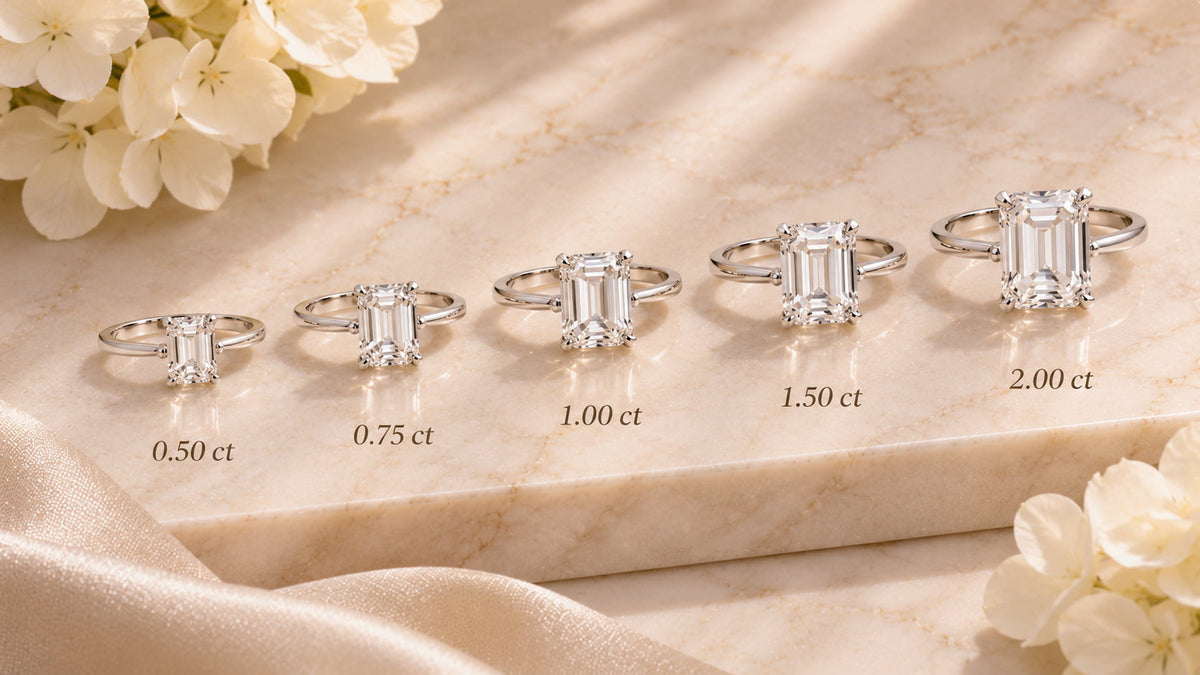
1 carat vs 2 carat diamond
On the chart, a 1 carat round diamond averages about 6.5 mm across and a 2 carat round about 8.2 mm.
To see the jump yourself, compare the same solitaire design at 1ct and 2ct diamond equivalent; several of our simulated diamond rings come in more than one size.
On Dani's simulated diamond rings, "1ct diamond equivalent" means the stone is cut to the size a 1-carat diamond would be. It describes size, not a graded diamond weight, and our guide to the 4Cs of diamonds explains the term.
How finger size and band width change how big a stone looks
GIA's styling advice: a big ring can overwhelm petite fingers and make them look even smaller, while long, slender fingers have the surface area for bigger stones. Larger fingers suit a wide stone and a medium to wide band.
As a rule of thumb, the same stone looks larger on a slimmer finger and smaller on a wider one.
Band width matters too. GIA notes a thin band can make a diamond look larger, while a thick band can make it appear smaller. On a larger finger, that is a real trade-off: the band that flatters the hand may not flatter the stone.
A slim wedding band keeps the stone prominent and stacks neatly beneath a solitaire after the wedding. Our round-up of matching wedding bands has more ideas.
How diamond shape affects size
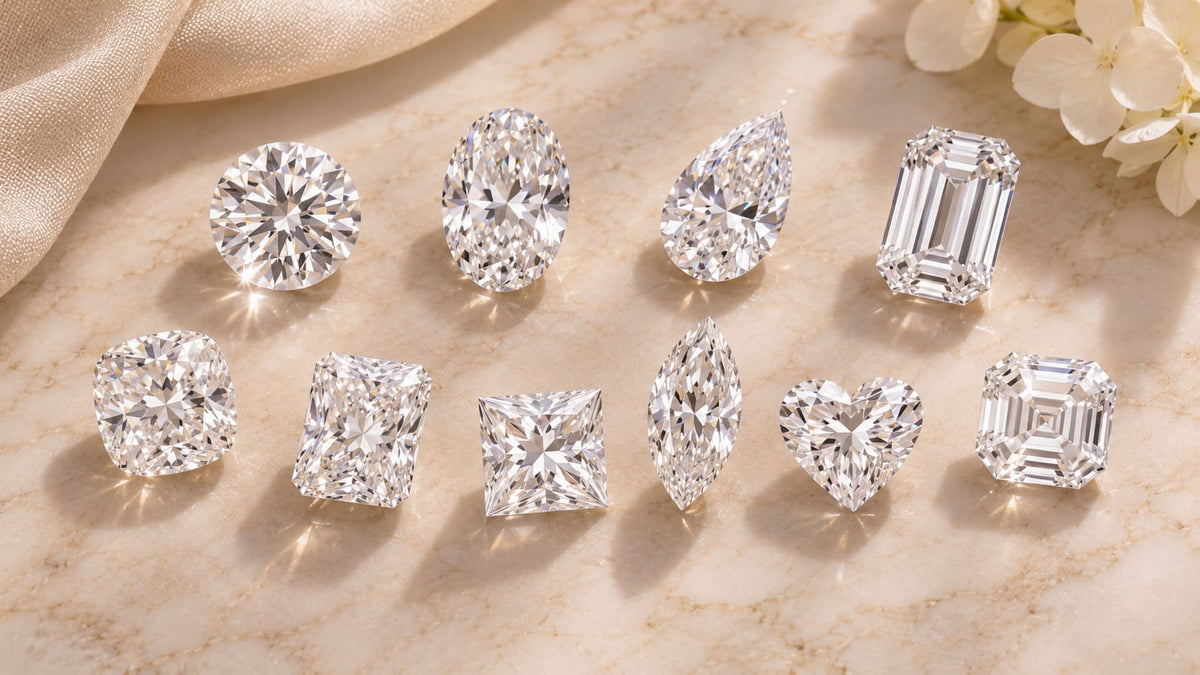
Carat numbers mislead across shapes. GIA notes that oval, pear and marquise can give the illusion of greater size, while cushion can look smaller than other shapes of the same carat weight.
An oval simulated diamond solitaire, for example, reads larger than a round of the same diamond-equivalent size. GIA adds that elongated shapes can accentuate the length of shorter fingers. Our guide to diamond shapes compares every outline.
How to get a bigger-looking stone for your budget
Lab-grown diamonds
A lab-grown diamond is a real diamond, with the same physical and chemical properties as a mined one, as our guide to whether lab-grown diamonds are real explains. In The Knot's study, lab-grown buyers ended up with larger stones on average while spending less than natural-diamond buyers.
Many 18K designs set several lab-grown diamonds rather than one center stone, from softly elongated ovals that wrap the finger to round brilliants mixed with pear teardrops. Browse them in our lab-grown diamond rings.
On multi-stone pieces, total diamond weight is the combined weight of every stone. Read it as how much lab-grown diamond the ring carries, not as the size of any single stone, and never compare it with a survey's center-stone average.
Simulated diamonds
Dani's simulated diamond rings come in 925 sterling silver at stated diamond-equivalent sizes, such as 1ct, 2ct or 3ct. A simulated stone is not a diamond and receives no diamond grading report, so judge it by how it looks to you. Our comparison of simulated vs lab-grown diamonds sets out the differences.
Halo and pavé settings
A halo frames the center stone with small stones, and GIA says the center can appear to be the size of the halo. GIA adds that the setting works best with a diamond center stone of 0.50 carat or more, and that halo prongs tend to wear out faster, so have them checked.
Pavé lines the band with small stones, which GIA says can make the center stone look larger. A split shank with pavé arms adds even more sparkle around the center. GIA's advice: skip pavé on the bottom of the shank, and expect occasional maintenance.
Stone size vs everyday wear
Height is where size and daily life collide. A higher setting can make a diamond look bigger, GIA notes, but it is more susceptible to damage and more likely to snag on clothing, gloves or hair. Lower profiles are less likely to catch, and GIA calls bezels a practical choice for people who work with their hands.
So for hands-on work, go lower before you go smaller: a low four-prong or bezel setting keeps a larger stone closer to the finger.
Engagement ring carat size FAQ
Is 1 carat big enough for an engagement ring?
It can be, especially on petite fingers, where GIA notes smaller rings tend to look better. A thin band or an elongated shape can also make a stone look larger.
What is the average engagement ring carat size?
It was 1.9 carats in The Knot's 2026 Real Weddings Study of US couples married in 2025.
Does a 2 carat diamond look big on the hand?
A 2 carat round diamond averages about 8.2 mm across, against about 6.5 mm for 1 carat (GIA). How big it looks depends on her finger width and the setting.
Do lab-grown diamonds let you go bigger for the same budget?
In The Knot's study, lab-grown buyers ended up with larger stones on average while spending less than natural-diamond buyers.
The bottom line
Choose the size that suits her hand and how she lives, then use shape, setting and stone type to reach it within budget. Before you decide, put a 1ct and a 2ct diamond-equivalent ring on the same hand and step back. Then compare sizes in our engagement rings and lab-grown diamond engagement rings.